From zero prompts to a scored, prioritized list — automatically.
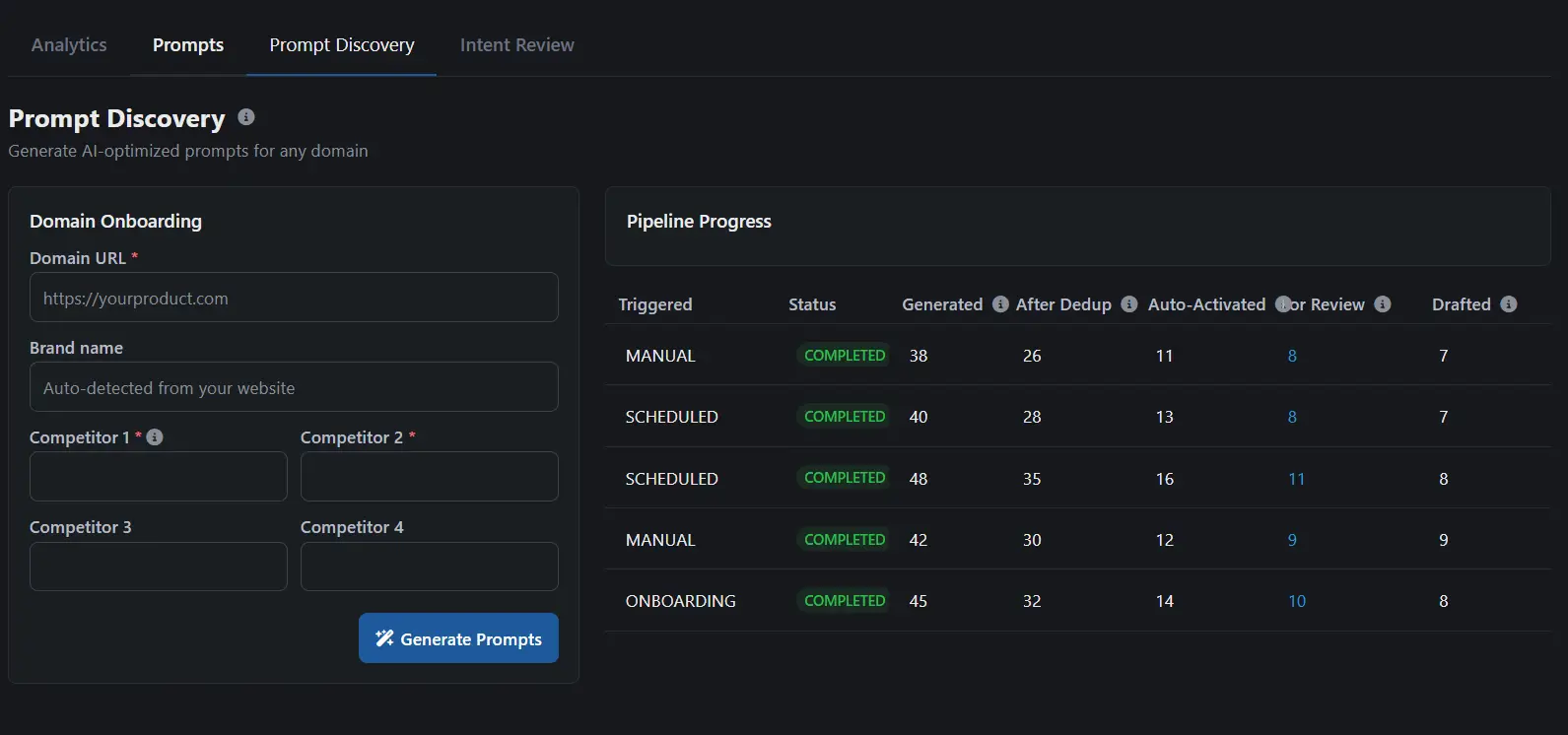
You provide your domain. Prompt Discovery fingerprints your positioning, indexes your content library, and generates prompt intents from two sources: a deterministic template engine and an LLM ideation pass. Every intent is scored on four independent factors, then routed to active monitoring, your Intent Review Queue, or drafts.
Available on Business + Diagnose and above
The 7-stage pipeline.
Prompt Discovery runs a 7-stage pipeline from the moment you connect your domain.
Fingerprint
Crawls your home page and up to 8 priority pages. Extracts a structured fingerprint: products, positioning, ICP signals, primary vertical, secondary verticals, key entities. Each field is tagged HIGH, MEDIUM, or LOW confidence so you know what to verify.
Index content library
Fetches your sitemap and samples up to 100 pages. Captures topic, intent served, key entities, evidence types, and CTA per page. This index is what Content Library Matching uses when diagnosing gaps.
Template expansion
A deterministic template engine generates 25–50 intents from proven query families — buying decisions, competitor comparisons, category definitions.
LLM ideation
An LLM pass generates additional intents for ICP-specific queries that templates can't cover. Each is pruned for schema completeness, entity specificity, and novelty before it advances.
Deduplication
Trigram Jaccard dedup removes overlapping intents across both sources. Same-family threshold 0.60, cross-family 0.50. When two intents tie for cluster representation, the deterministic template version wins.
Factor scoring
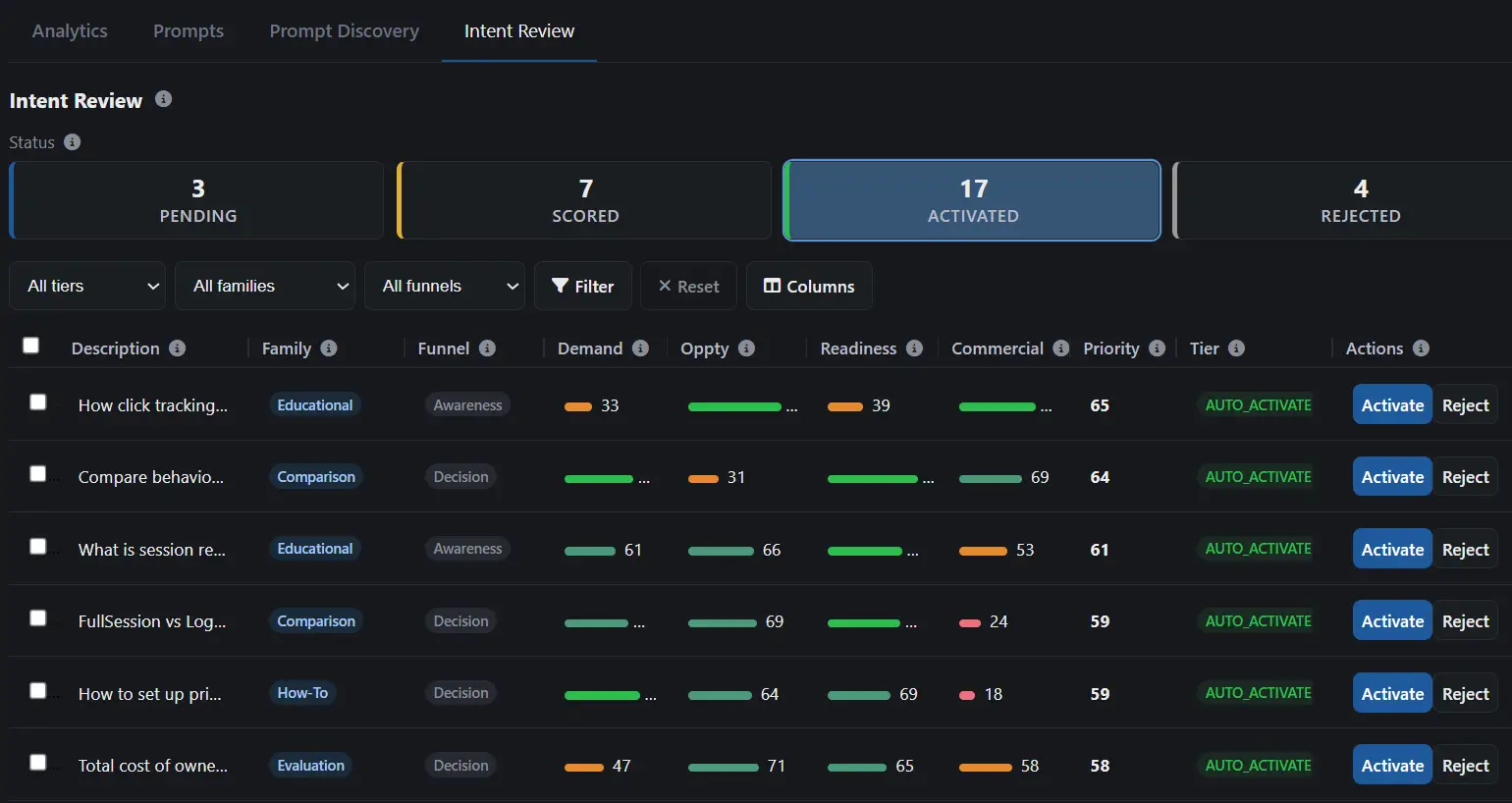
Each surviving intent is scored independently on four factors: Demand Evidence, Citation Opportunity, Content Readiness, and Commercial Value. Scores are stored separately — no collapsed composite.
Activation routing
Intents are sorted into three tiers. High-priority intents (priority score ≥ 70) auto-activate and enter monitoring immediately. Mid-range intents go to your Intent Review Queue. Low-confidence intents save as drafts.
Four independent factor scores.
Every intent carries four scores, stored separately, not collapsed into one number. Sorting by a single factor reveals different things.
A prompt with high Citation Opportunity and low Content Readiness is a different problem than one with high Demand Evidence and high Content Readiness. You decide which gaps to close first based on the signal that matters to your team right now.
Demand Evidence
Real search signal behind this query, grounded in DataForSEO data.
Citation Opportunity
Are competitors being cited for this prompt while you're absent?
Content Readiness
Do you already have a page in your library that could win this prompt?
Commercial Value
Does this prompt sit in the buyer journey, and at which stage?
Activation routing and the Review Queue.
Not all intents are equal in confidence. The pipeline routes each intent to the tier that matches its signal strength.
Priority ≥ 70
Auto-activate
High demand, high citation opportunity, clear commercial value — these enter monitoring immediately without review.
Priority 45–69
Review Queue
You see all four factor scores, the matched content page, and the business value tier. You activate, edit, or reject.
Priority < 45
Drafts
Low-confidence intents save as drafts. Inspect them at any time and promote manually when the signal improves.
You don't write prompts. You don't import a list. The pipeline builds the list — you control what gets monitored.
How it works
Connect
Provide your domain URL. The 7-stage pipeline starts automatically.
Score
Stages 1–6 fingerprint, generate, dedup, and score every intent in minutes.
Route
High-priority intents activate. Mid-range intents go to your Intent Review Queue. You decide what gets monitored.
Prompt Discovery is the input to the Rankwize monitoring and Diagnose pipeline.